Suggested SEO title: Utah Lawyer Marketing: 9 Ways to Get More Qualified Clients
Meta description: Learn nine practical Utah lawyer marketing strategies for attracting qualified clients in Salt Lake City, Provo, and across the Wasatch Front.
Suggested URL slug: utah-lawyer-marketing-salt-lake-city-provo
If your firm wants more qualified clients in Salt Lake City, Provo, or another Wasatch Front market, more traffic is not enough.
You need the right prospects to find your firm, trust your experience, and contact you through a trackable intake process.
The following Utah lawyer marketing strategies can help you build that system.
1. Optimize your Google Business Profile
Your Google Business Profile can influence how prospective clients find your firm in local search and Maps.
Start with the basics:
- Use your exact firm name, address, and phone number.
- Select the most accurate primary category for your firm.
- Add relevant secondary categories when appropriate.
- List your primary practice areas clearly.
- Keep office hours and contact details current.
- Add professional photos of your office and attorneys.
- Publish occasional updates, FAQs, and educational content.
Use location references naturally. Your profile and website may mention Salt Lake City, Provo, Orem, Lehi, Sandy, Draper, West Jordan, South Jordan, and other communities you genuinely serve.
Do not add locations where you have no meaningful presence. Thin or misleading location signals can reduce trust and create compliance concerns.
Wasatch Made can help with Local SEO and Map Pack Optimization for law firms, including local visibility, practice-area targeting, and conversion tracking.

2. Target high-intent Utah legal keywords
Broad keywords often create broad, inconsistent inquiries.
Build your strategy around searches that show a clear legal need. Examples include:
- Salt Lake City personal injury lawyer
- Provo criminal defense attorney
- Utah County family law attorney
- Salt Lake City estate planning lawyer
- Orem divorce attorney
- South Jordan business litigation lawyer
- Utah DUI defense attorney
Your best keywords usually combine three elements:
- A practice area.
- A location or jurisdiction.
- A service or attorney intent.
Create a keyword map before publishing pages. Each important search should have one logical page on your website.
This prevents multiple pages from competing against one another. It also helps you identify which practice areas deserve more content, paid advertising, or intake attention.
3. Build dedicated practice-area pages
A single “Services” page cannot fully explain every type of case your firm handles.
Create a useful page for each priority practice area. Depending on your firm, that could include:
- Personal injury
- Family law
- Criminal defense
- Estate planning
- Business litigation
- Employment law
- Immigration
- Real estate law
Each page should explain who you help, what types of matters you handle, where you serve clients, and how to take the next step.
Include:
- A clear page title.
- A concise explanation of the practice area.
- Relevant attorney credentials.
- Common questions.
- A visible call button.
- A secure consultation or case-evaluation form.
- Appropriate disclaimers and advertising disclosures.
Avoid copying the same page and changing only the city name. Salt Lake City and Provo pages should contain genuinely useful local information and reflect the cases you actually accept.
4. Create useful city and jurisdiction content
Local authority requires more than adding city names to page titles.
Publish content that helps people understand how to begin. Examples include:
- How to prepare for an initial consultation in Utah.
- Questions to ask before hiring a family law attorney.
- What information to bring to a criminal defense consultation.
- Common estate planning concerns for Utah families.
- How your firm serves clients in Utah County or Salt Lake County.
You can also create location pages for communities that are strategically important to your practice.
Reference local courts, counties, and service areas accurately. Do not make specific legal claims without attorney review.
For authoritative local resources, firms can also direct readers to the Utah State Bar’s lawyer referral information and the Licensed Lawyer referral service.
5. Build a consistent review process
Reviews help prospective clients evaluate your firm before they call.
They may also support local visibility when they are authentic, recent, and relevant to your business.
Create a repeatable process for requesting reviews after appropriate client milestones. Your process should be reviewed for compliance with applicable professional responsibility rules.
Ask for honest feedback. Do not pressure clients to use specific language or promise an incentive in exchange for a positive review.
Respond professionally to both positive and negative feedback. Avoid discussing confidential facts or confirming details about a client’s matter in a public response.
Reputation management should be part of your marketing system, not an occasional task. Wasatch Made’s Reputation Engineering service can help organize review requests and response workflows.
6. Improve your website’s conversion path
A prospective client should not have to search for your phone number or guess what to do next.
Your website should make the next step obvious on mobile and desktop.
Review these elements:
- Is the phone number visible near the top of every page?
- Can visitors reach your intake form in one click?
- Does each practice-area page have a relevant call to action?
- Are attorney bios easy to find?
- Are credentials, memberships, and reviews presented clearly?
- Does the site load quickly on a mobile connection?
- Does the form collect enough information to route the inquiry?
- Are privacy notices and disclaimers easy to understand?
Your website should establish credibility without making unsupported promises. Avoid guarantees, inflated case results, or language that could conflict with Utah advertising rules.
See Wasatch Made’s high-conversion web design for lawyers for a law firm website built around credibility, local search, and case intake.

7. Use Google PPC and Local Services Ads carefully
Search engine optimization takes time. Paid search can help you reach high-intent prospects while organic visibility develops.
Build campaigns around your strongest practice areas and service locations. Separate campaigns by practice area so you can see which matters produce qualified inquiries.
Use negative keywords to reduce irrelevant clicks. Depending on your practice, those may include searches for jobs, law school, free forms, legal definitions, or unrelated services.
Local Services Ads may also be available for certain legal categories and markets. Availability, screening requirements, and performance can change, so confirm current eligibility before planning around the channel.
Paid campaigns should lead to dedicated landing pages. The landing page should match the search intent, explain the next step, and make the consultation process clear.
Wasatch Made provides Google PPC and Local Service Ads Management for law firms with a focus on lead quality, routing, and measurable acquisition costs.
8. Capture inquiries after hours
Legal inquiries do not always arrive during office hours.
A missed call or unanswered form can become a lost opportunity, especially when several firms appear in the same search results.
Consider adding:
- Immediate form notifications.
- Text or email confirmation after submission.
- After-hours call routing.
- Appointment scheduling.
- Basic intake qualification.
- Automated follow-up for unreturned inquiries.
AI chat and voice tools can help with initial information collection and appointment requests. They should not provide legal advice, create an attorney-client relationship, or collect sensitive information through an unsecured process.
Set clear boundaries. Tell visitors that automated responses are not legal advice and that a consultation is required for case-specific guidance.
Wasatch Made’s AI Chat and Voice Bots for lead capture can be evaluated as part of a broader intake system.
9. Measure signed cases, not just leads
Lead volume is an incomplete marketing metric.
A campaign that generates 50 inquiries but no signed matters may be less valuable than one that generates 10 inquiries and three signed cases.
Track each inquiry through these stages:
- Website visitor.
- Phone call or form submission.
- Qualified lead.
- Consultation booked.
- Consultation completed.
- Retainer or engagement signed.
- Case value or projected value.
Review lead quality by practice area, location, source, and intake status.
Useful metrics include:
- Qualified lead rate.
- Consultation booking rate.
- Consultation show rate.
- Signed-case rate.
- Cost per qualified lead.
- Cost per consultation.
- Cost per signed case.
- Revenue by marketing source.
A simple cost-per-signed-case formula is:
Total marketing and intake spend ÷ number of signed cases
For example, if your firm spends $6,000 on marketing and intake during a month and signs six cases, the cost per signed case is $1,000.
The number becomes useful when it is tied to case economics and measured consistently. Your CRM should record the original source, campaign, landing page, call, and final intake outcome.
Wasatch Made can support Lead Tracking and Attribution and CRM Automation for law firm intake so you can see which channels create signed matters.

A practical 90-day Utah lawyer marketing plan
You do not need to launch every tactic at once.
Days 1–30: Fix the foundation
- Audit your Google Business Profile.
- Review your website’s mobile experience.
- Identify your highest-value practice areas.
- Map keywords to existing and new pages.
- Install call, form, and appointment tracking.
- Review advertising language for compliance.
Days 31–60: Build local authority
- Publish or improve practice-area pages.
- Create priority city and jurisdiction content.
- Start a consistent review request process.
- Improve attorney bios and trust signals.
- Connect forms and calls to your CRM.
Days 61–90: Add and optimize acquisition channels
- Launch tightly targeted PPC campaigns.
- Evaluate Local Services Ads eligibility.
- Add after-hours intake support.
- Review qualified lead and signed-case data.
- Shift budget toward the sources producing accepted matters.
Choose a marketing plan based on your numbers
Utah lawyer marketing should be tied to your practice areas, service locations, intake capacity, and case economics.
Wasatch Made brings 16 years of industry-specific marketing experience, upfront projections, and a month-to-month service model with no long-term contracts. Before you spend, you can request a plan showing projected lead volume, cost-per-client estimates, and the services recommended for your market.
Request a free Utah law firm growth analysis. No legal advice is provided, and results are not guaranteed. Your firm should review all marketing and intake processes for compliance with applicable rules.
Suggested image alt text
- Hero image: Modern Utah law office with marketing analytics and Salt Lake City mountain views.
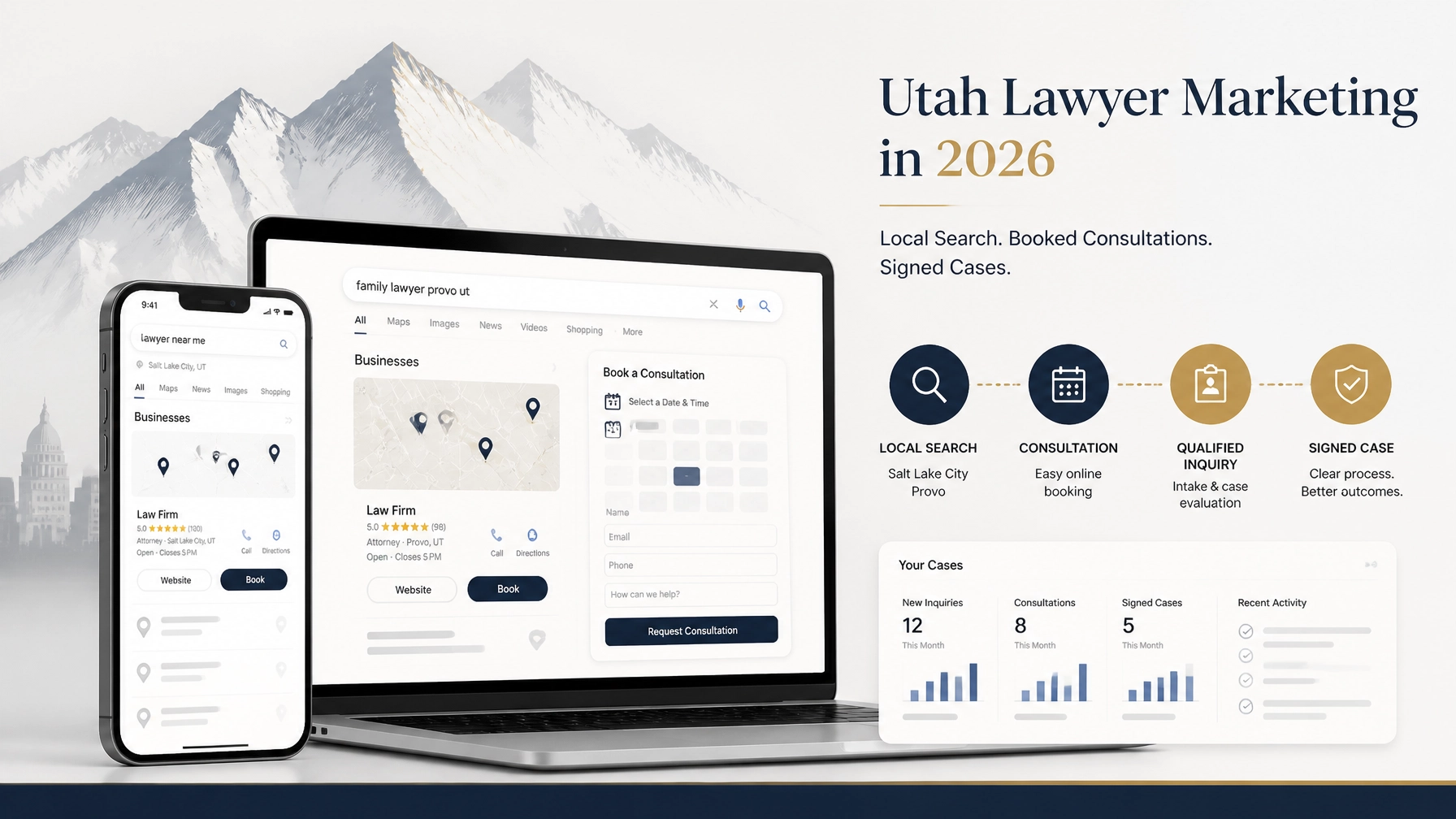
- Inline image 1: Laptop and smartphone showing a fictional local search map with Utah location pins and review indicators.
- Inline image 2: Mobile and desktop screens displaying a fictional high-conversion law firm website.
- Inline image 3: Marketing attribution dashboard showing abstract lead stages and signed-case trends between Salt Lake City and Provo.