Meta description: Learn how Utah lawyers can build a complete case acquisition funnel using local SEO, Google Business Profile, AI search, ethical reviews, paid ads, fast intake, and signed-case attribution.
Hi there. Visibility is only the first step in lawyer marketing.
A law firm can appear in Google, receive calls, and still lose qualified cases because the website, intake process, follow-up, and reporting are not connected. Your goal is not more traffic. It is a predictable path from a local search to a signed client.
This guide explains how to build that path for Salt Lake City, Provo, and the Wasatch Front.
Start by defining a qualified case
Marketing performs better when your firm has a clear definition of a qualified lead.
A qualified case inquiry should usually match four criteria:
- The prospect needs a practice area your firm handles.
- The matter falls within your jurisdiction and service area.
- The prospect meets your basic case or financial criteria.
- The firm can contact and evaluate the prospect promptly.
Your criteria will differ by practice area. A personal injury firm may ask about the accident date, injuries, location, and insurance coverage. A family law firm may need to know the county, case status, and whether a proceeding has already started.
Build these criteria into your:
- Landing pages
- Contact forms
- Phone intake scripts
- Chat and voice bot workflows
- CRM pipeline
- Reporting dashboard
This prevents your marketing team from optimizing for inexpensive inquiries that never become consultations or signed matters.
Build the funnel around Utah search behavior
A complete case acquisition funnel has five stages:
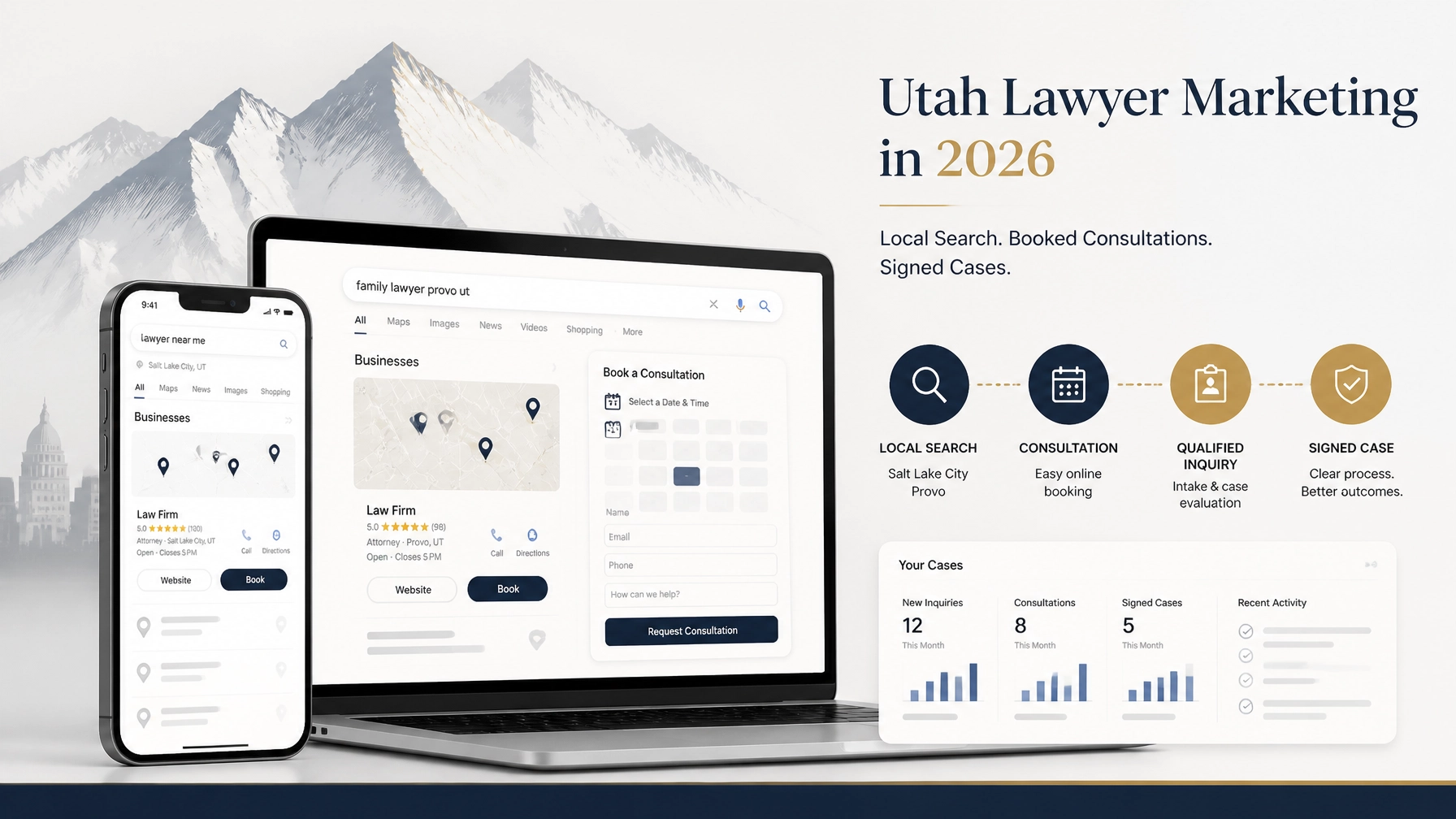
- Visibility: A prospect finds your firm through search, Maps, AI results, or advertising.
- Trust: The prospect confirms your practice area, location, experience, and credibility.
- Conversion: The prospect calls, submits a form, starts a chat, or books a consultation.
- Qualification: Your intake process determines whether the matter fits your firm.
- Retention: The prospect signs an engagement agreement and enters your case-management process.
Each stage needs its own measurement. A high search ranking does not fix a slow phone response. A strong website does not fix weak follow-up.

Create practice-area and location combinations
A page titled “Utah Lawyer” is too broad to match most high-intent searches.
Your site should organize content around the services you provide and the locations you serve. Examples include:
- Salt Lake City personal injury lawyer
- Provo divorce attorney
- Orem criminal defense lawyer
- Sandy estate planning attorney
- Utah County business litigation lawyer
- Salt Lake County employment lawyer
Each page should provide useful local information. Do not simply replace the city name on the same template.
A strong location page explains:
- The types of matters you handle
- The clients you serve
- The counties or communities covered
- The consultation process
- Relevant local court or jurisdiction information
- What a prospective client should prepare before contacting the firm
- Clear limitations on the information provided
Use local references only when they are accurate and relevant. A page can mention Salt Lake City, Provo, Utah County, or the Third District Court without pretending that a generic paragraph is local expertise.
Geo-specific authority comes from useful detail, accurate business information, local relationships, and consistent service, not keyword repetition.
Optimize your Google Business Profile for qualified inquiries
Your Google Business Profile is often the first conversion point for local legal searches.
Review the profile for:
- Correct firm name
- Accurate address and phone number
- Appropriate primary and secondary categories
- Current hours and holiday hours
- Correct website and appointment links
- Complete practice-area services
- Office photos and attorney photos
- Accurate service-area information
Use the real firm name. Do not add phrases such as “Best Salt Lake City Injury Lawyer” to the business name unless that is the firm’s actual legal name.
Your profile should also support the next step. The phone number should work. The website should load quickly on mobile devices. The consultation link should lead to a focused page instead of a confusing homepage.
Track calls from the profile separately from calls generated by paid ads and organic search. Otherwise, the source of each signed case remains unclear.
Generate reviews ethically
Reviews help prospects evaluate your firm. They can also support local visibility.
Review generation must be handled carefully by legal practices. Use a consistent, permission-based process that asks real clients for honest feedback after an appropriate case milestone or service interaction.
Avoid:
- Incentivizing reviews
- Asking only satisfied clients to post
- Telling clients what words to use
- Revealing confidential case information
- Responding with facts that identify the client or matter
- Promising a result in response to a review
A professional response can acknowledge the feedback without discussing representation. For example: “Thank you for sharing your experience. We appreciate your feedback and are glad our team was able to assist.”
Reviews should support trust. They should not be engineered to create a misleading impression.
Make AI search part of the same funnel
AI search and answer engines can introduce your firm before a prospect visits your website.
Your goal is not to manufacture recommendations. It is to make your firm’s information clear, accurate, and easy for search systems to understand.
Publish useful answers to questions such as:
- What should I do after a car accident in Salt Lake City?
- How does a divorce case begin in Utah County?
- When should I contact a criminal defense attorney in Provo?
- What documents should I bring to an estate planning consultation?
Use clear headings, short answers, attorney authorship, updated legal references, and accurate location information. Add appropriate structured data so search engines can understand your firm, attorneys, services, and locations.
AI visibility should send people into the same conversion process as every other channel. A prospect who discovers your firm through an AI answer still needs a clear next step, a trustworthy website, and responsive intake.
Build a website that converts on mobile
Many legal searches happen on a phone. The first screen should answer three questions:
- What does your firm handle?
- Where does it practice?
- What should I do next?
Use one primary call to action, such as “Request a Consultation” or “Speak With Our Team.” Keep the form short. Ask only for information needed to begin the conversation.
A conversion-focused law firm website should include:
- Click-to-call functionality
- Short, accessible intake forms
- Practice-area landing pages
- Attorney biographies with relevant experience
- Clear service locations
- Consultation expectations
- Privacy information
- Visible disclaimers
- Human contact options

An AI chat or voice bot can capture after-hours inquiries. It should identify itself as automated, avoid giving legal advice, collect only necessary information, and offer a clear path to a qualified team member.
Do not treat a chatbot as a substitute for attorney review. Configure escalation rules for emergencies, deadlines, conflicts, active representation, and sensitive information.
Respond to inquiries quickly
Speed matters because legal prospects often contact several firms.
Set a response workflow for:
- Missed calls
- Web forms
- Chat conversations
- Text messages
- Consultation requests
- Local Services Ads leads
The first response should confirm receipt and explain what happens next. It should not imply that an attorney-client relationship has been created.
Your CRM can assign each inquiry to an intake team member, send reminders, record contact attempts, and flag leads that have not received a response. Follow-up should be persistent but respectful.
Track the full sequence:
- New inquiry
- First contact attempted
- Contact made
- Qualified
- Consultation scheduled
- Consultation completed
- Retainer sent
- Signed case
- Referred or declined
Use Google PPC and Local Services Ads selectively
Paid search can help you test demand while organic visibility develops.
Create campaigns around high-intent combinations, such as:
- Practice area plus Salt Lake City
- Practice area plus Provo
- Emergency or urgent legal need terms
- County-specific legal services
- Consultation-focused searches
Send each campaign to a relevant landing page. Use negative keywords to limit unrelated searches, including education, employment, free forms, and other terms outside your intake criteria.
Google Local Services Ads may be available for certain legal categories and markets. Eligibility, screening requirements, and availability can change, so confirm current requirements before building your budget around the channel.
For both PPC and Local Services Ads, measure more than clicks and leads. Review lead quality, contact rate, consultation rate, and signed-case rate.
Track cost per qualified lead and signed case
Your reporting should connect marketing activity to firm outcomes.
Use these basic calculations:
Cost per qualified lead
Total marketing cost ÷ qualified inquiries
Cost per consultation
Total marketing cost ÷ completed consultations
Cost per signed case
Total marketing cost ÷ signed cases
Track these numbers by:
- Practice area
- City or county
- Campaign
- Search term
- Landing page
- Call source
- Form source
- Intake team member
- Month
Call tracking can identify which channel produced a conversation. Form attribution can connect a submission to the original campaign. CRM automation can show whether that inquiry became a signed matter.

Do not use projected revenue as proof of future performance. Use it as a planning tool. Review actual signed-case data each month and adjust budgets, pages, intake scripts, and follow-up sequences accordingly.
Build a 12-month plan before spending more
A strong Utah lawyer marketing plan should show what happens over time.
The first 30 days may focus on tracking, Google Business Profile cleanup, intake response, and conversion problems. The next 60 to 90 days may add practice-area pages, technical improvements, review workflows, and targeted paid campaigns.
Later months can expand content, authority, AI search visibility, referral partnerships, and conversion testing.
At Wasatch Made, our law firm marketing service is built around a data-backed 12-month plan. We show projected lead volume, intake assumptions, cost-per-client estimates, and the services required before you commit to execution.
You can also contact Wasatch Made or request the free five-minute analysis for your Salt Lake City, Provo, or Wasatch Front market.
Hi there. If your firm is generating inquiries but not enough signed cases, the problem may be in the funnel: not the traffic. Review each stage, measure the handoffs, and fix the point where qualified prospects are being lost.
Legal marketing disclaimer
This article provides general marketing information. It is not legal advice, an ethics opinion, or a guarantee of rankings, leads, consultations, signed cases, revenue, or case outcomes. Utah lawyers and law firms should review all advertising, testimonials, lead-generation arrangements, automated communications, and website content under the current Utah Rules of Professional Conduct and applicable advertising requirements. See Utah Rule 7.2 and consult qualified ethics counsel when needed.
Image alt-text suggestions
- Modern Utah law office with a case acquisition funnel dashboard and Wasatch mountain skyline.
- Local search, phone calls, web forms, and CRM stages connected across Salt Lake City and Provo.
- Mobile-first legal consultation website with call, form, calendar, and CRM workflow.
- Law firm marketing dashboard showing source attribution, qualified leads, consultations, and signed cases.