
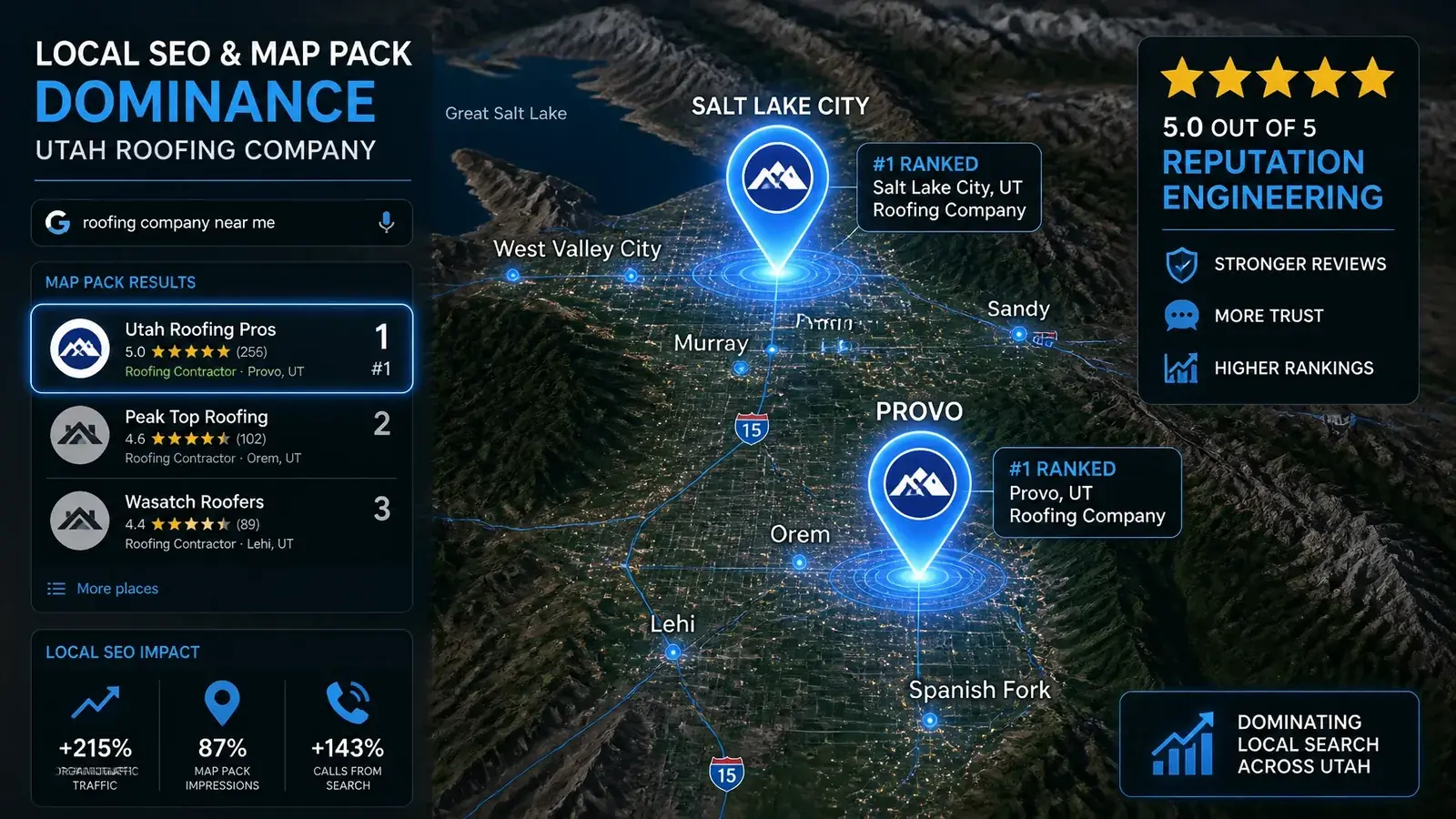
Hi there. If you own a roofing company in Utah, your next customer is likely searching before they ever call.
They may search Google Maps for a roofer near them. They may ask Google’s AI which contractor handles storm damage in Provo. They may compare reviews, photos, services, and response times before choosing one company.
Your marketing must now perform across all of these search experiences.
Why Utah roofing marketing is changing in 2026
Roofing demand along the Wasatch Front is competitive and seasonal. Snow, wind, hail, intense sunlight, and aging shingles create consistent demand for repairs and replacements.
Salt Lake City and Provo are also crowded search markets. Homeowners can choose from dozens of contractors. The companies that win visibility are usually the ones with:
- Strong Google Business Profiles.
- Specific service-area content.
- Consistent reviews.
- Fast lead response.
- Clear project proof.
- Accurate conversion tracking.
- Websites that answer homeowner questions directly.
Google’s AI search does not replace traditional SEO. Google states that AI Overviews and AI Mode rely on the same core search systems. Pages must still be crawlable, indexed, eligible for a normal search snippet, and useful to people.
There is no special “AI ranking hack.” The solution is a clear, trustworthy local search strategy.
Build a Local SEO foundation for Salt Lake City and Provo
Optimize your Google Business Profile
Your Google Business Profile is one of your most important marketing assets. It can appear in Google Maps, the Local Pack, standard search results, and AI-generated local recommendations.
Start with the basics:
- Select the most accurate primary category, such as “Roofing Contractor.”
- Add relevant services, including roof repair, roof replacement, storm damage inspection, and emergency leak repair.
- Define your service area accurately.
- Keep your business name, address, phone number, and hours consistent.
- Add original photos of your crews, trucks, projects, and completed roofs.
- Publish regular updates about local projects and seasonal services.
- Answer common questions in the profile’s Q&A section.
Use real project photos whenever possible. A photo of your team working on a home in Sandy or Orem provides stronger local context than a generic stock image.
Do not claim to serve every Utah city if you cannot respond there. Accurate service areas support better customer expectations and stronger lead quality.
Create useful city and service pages
A single “Utah roofing contractor” page is not enough for a company targeting multiple markets.
Build dedicated pages for services and locations, such as:
- Roof repair and replacement marketing
- Salt Lake City roof replacement.
- Provo emergency roof repair.
- Sandy storm damage roofing.
- Draper hail damage inspections.
- Orem asphalt shingle replacement.
- South Jordan insurance claim assistance.
Each page should contain original information. Avoid changing only the city name on duplicate pages.
A useful Salt Lake City page could discuss homes and neighborhoods in Sugar House, Millcreek, West Valley City, and the east bench. A Provo page could address service coverage in Orem, Springville, Spanish Fork, and nearby Utah County communities.
Include:
- Services offered in that area.
- Local project examples.
- Common roofing problems.
- Clear service limitations.
- Reviews from real customers.
- Before-and-after images.
- A click-to-call button.
- A short inspection or estimate form.
Google’s current guidance recommends making important content available in text, supporting it with high-quality images, and linking pages clearly throughout your website.
Make your roofing website useful to AI search
Answer the questions homeowners actually ask
AI search often handles longer, conversational questions. A homeowner may ask:
- “Who can inspect hail damage on my roof in Salt Lake City?”
- “Should I repair or replace my roof before winter in Provo?”
- “Does homeowners insurance cover wind damage in Utah?”
- “How long does a roof replacement take?”
- “What does a new roof cost for a Utah County home?”
Create straightforward answers on your service pages and in a roofing FAQ hub.
Explain your process. Show what happens during an inspection. Clarify what information homeowners should prepare for an insurance claim. Explain when a repair makes sense and when replacement is more practical.
The goal is not to write for a machine. The goal is to publish information that helps a homeowner make a good decision. That is also the type of information Google’s AI systems are designed to retrieve and summarize.
Use GEO without chasing shortcuts
Generative Engine Optimization, or GEO, is often described as optimizing content for AI platforms.
For a roofing company, the practical work includes:
- Clearly stating what services you provide.
- Naming the cities and areas you actually serve.
- Publishing first-hand project information.
- Showing credentials, warranties, and experience.
- Keeping your business details consistent online.
- Connecting service pages, location pages, and related articles.
- Building a strong reputation across relevant platforms.
Google’s official guidance says you do not need special AI-only markup, llms.txt files, or unusual content formats to appear in generative search. Standard SEO fundamentals remain the foundation.
Structured data can still help search engines understand your business. Use appropriate LocalBusiness, Service, BreadcrumbList, and FAQPage markup when the information is visible on the page. The markup must match the actual content.
Use reviews as a local growth system
Reviews influence homeowner trust, Google Maps visibility, Local Services Ads performance, and the information AI systems use to understand local businesses.
Ask for honest feedback after completed work. Make the process simple. Send the request when the customer is most satisfied with the result.
A strong review may mention:
- The service completed.
- The city or neighborhood.
- The company’s communication.
- The speed of the response.
- The quality of the finished roof.
Never script false reviews or offer incentives that violate platform policies. The objective is a consistent system that makes it easy for real customers to share real experiences.
Respond to positive and negative reviews. Keep responses professional. Address problems directly and invite the customer to continue the conversation privately when needed.
This process is part of Reputation Engineering. It turns completed jobs into ongoing trust signals.
Combine Local SEO with paid lead generation
SEO builds a long-term asset. Paid search creates immediate visibility.
Both can be useful for a Utah roofing contractor.
Use Google Ads for immediate demand
Google Ads can target high-intent searches such as:
- Emergency roof repair Salt Lake City.
- Roof replacement Provo.
- Hail damage inspection near me.
- Roof leak repair Orem.
- Insurance roofing contractor Utah County.
Separate campaigns by city and service. Send each ad to a relevant landing page instead of a generic homepage.
Track calls, forms, booked inspections, and closed jobs. A low cost per click does not matter if the leads do not become revenue.
Use Local Services Ads for call-driven searches
Local Services Ads can place your business near the top of local search results for eligible roofing services.
Your profile should include accurate service types, service areas, hours, photos, and reviews. Lead quality should be monitored closely. Dispute invalid leads when appropriate and record the outcome of every legitimate lead.
For a deeper comparison, read Google Ads vs. Local SEO: Which Is Better for Your Utah Roofing Business?.
Respond to leads before competitors do
A homeowner with an active leak may contact several roofers. The first qualified company to respond often gets the inspection opportunity.
Missed calls and slow follow-up create avoidable revenue loss.
An AI chat or voice system can:
- Answer calls after hours.
- Identify repair, replacement, and storm-damage inquiries.
- Collect the homeowner’s city and contact details.
- Ask basic qualifying questions.
- Schedule an inspection.
- Send the lead to your CRM.
- Alert your team immediately.
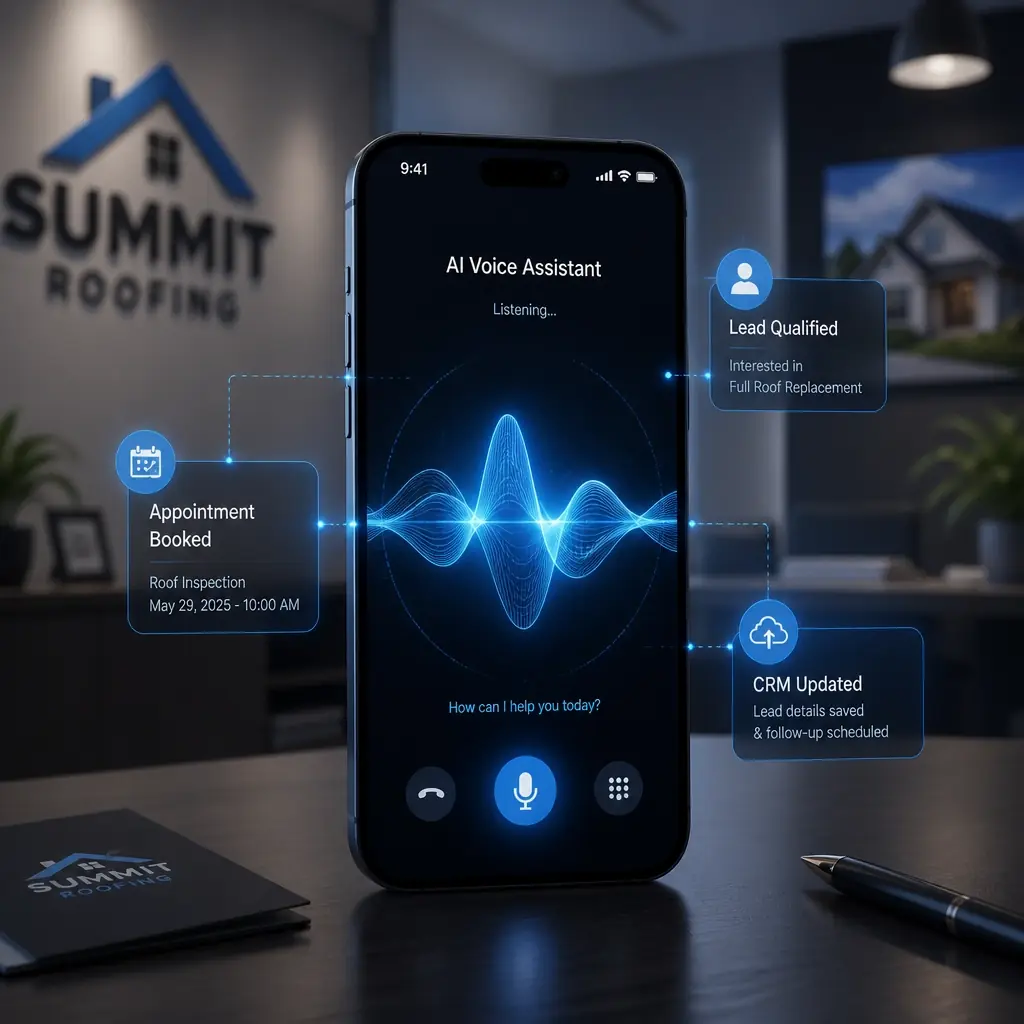
The system should support your team, not replace judgment. Your project manager still handles complex estimates, insurance questions, and customer conversations.
Read How to Prepare for AI Calling Your Utah Roofing Business for a related look at AI voice technology.
Track marketing through closed revenue
Leads are not the final metric. Closed jobs are.
Your tracking system should connect:
- Search query.
- Google Business Profile interaction.
- Ad click.
- Phone call.
- Form submission.
- Booked inspection.
- Estimate.
- Sold job.
- Revenue.
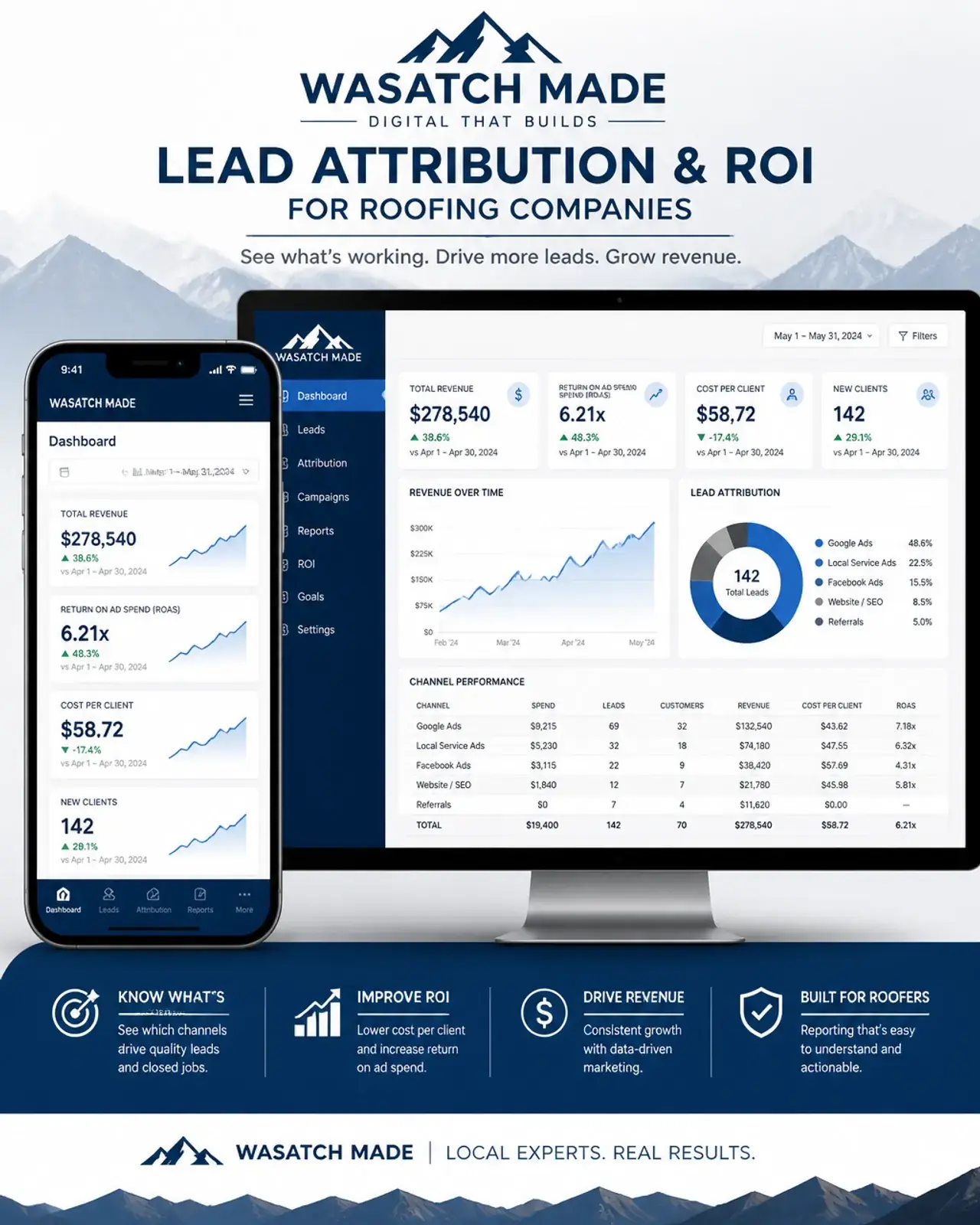
This makes it easier to identify which services, cities, and campaigns produce profitable work.
It also prevents common reporting problems. Impressions and clicks can look positive while the sales pipeline remains weak. Full-stack tracking shows where leads are lost and where follow-up needs improvement.
A practical 90-day plan for Utah roofers
Days 1–30: Fix the foundation
- Audit your Google Business Profile.
- Correct name, address, phone, and hours inconsistencies.
- Improve your service list and business description.
- Add original project photos.
- Review mobile speed and conversion paths.
- Install call tracking and form tracking.
Days 31–60: Build local authority
- Create or improve Salt Lake City and Provo service pages.
- Add supporting pages for nearby cities you genuinely serve.
- Publish roofing FAQs based on real customer questions.
- Add internal links between services, locations, and blog content.
- Start a consistent review request process.
Days 61–90: Improve lead flow
- Launch or refine Google Ads and Local Services Ads.
- Add AI chat or voice support for missed and after-hours calls.
- Connect every lead source to your CRM.
- Track booked inspections and sold jobs.
- Adjust budget toward the cities and services producing the best return.
Build a measurable Utah roofing growth plan
Your marketing budget should support a business goal. That may be more replacement jobs, a fuller storm-season schedule, higher-margin insurance work, or expansion into Provo and Salt Lake City.
Wasatch Made builds done-for-you growth systems for home service businesses. Our team combines Local SEO, high-conversion web design, GEO, PPC, Local Services Ads, reputation management, AI lead capture, CRM automation, and attribution tracking.
Before you spend, you receive a data-backed 12-month plan with projected revenue, cost-per-client estimates, and a service breakdown. Services are month to month. No long-term contract is required.

Ready to grow your Utah roofing company?
Start with the free five-minute roofing growth analysis.
You will see where your current marketing is leaking leads, what it may cost to acquire a customer, and which channels can support your Salt Lake City or Provo growth goals.