Suggested SEO title: Utah Lawyer Marketing in 2026: Turn SLC and Provo Searches Into Cases
Meta description: Learn how Utah law firms can convert Salt Lake City, Provo, and Wasatch Front searches into qualified, trackable cases with local SEO, GBP, PPC, AI search, and intake automation.
URL slug: /utah-lawyer-marketing-salt-lake-city-provo/
Hi there. Visibility is not the same as growth.
Your firm can rank for “lawyer near me” and still lose the case because the wrong people call, the website fails to build trust, or no one follows up quickly.
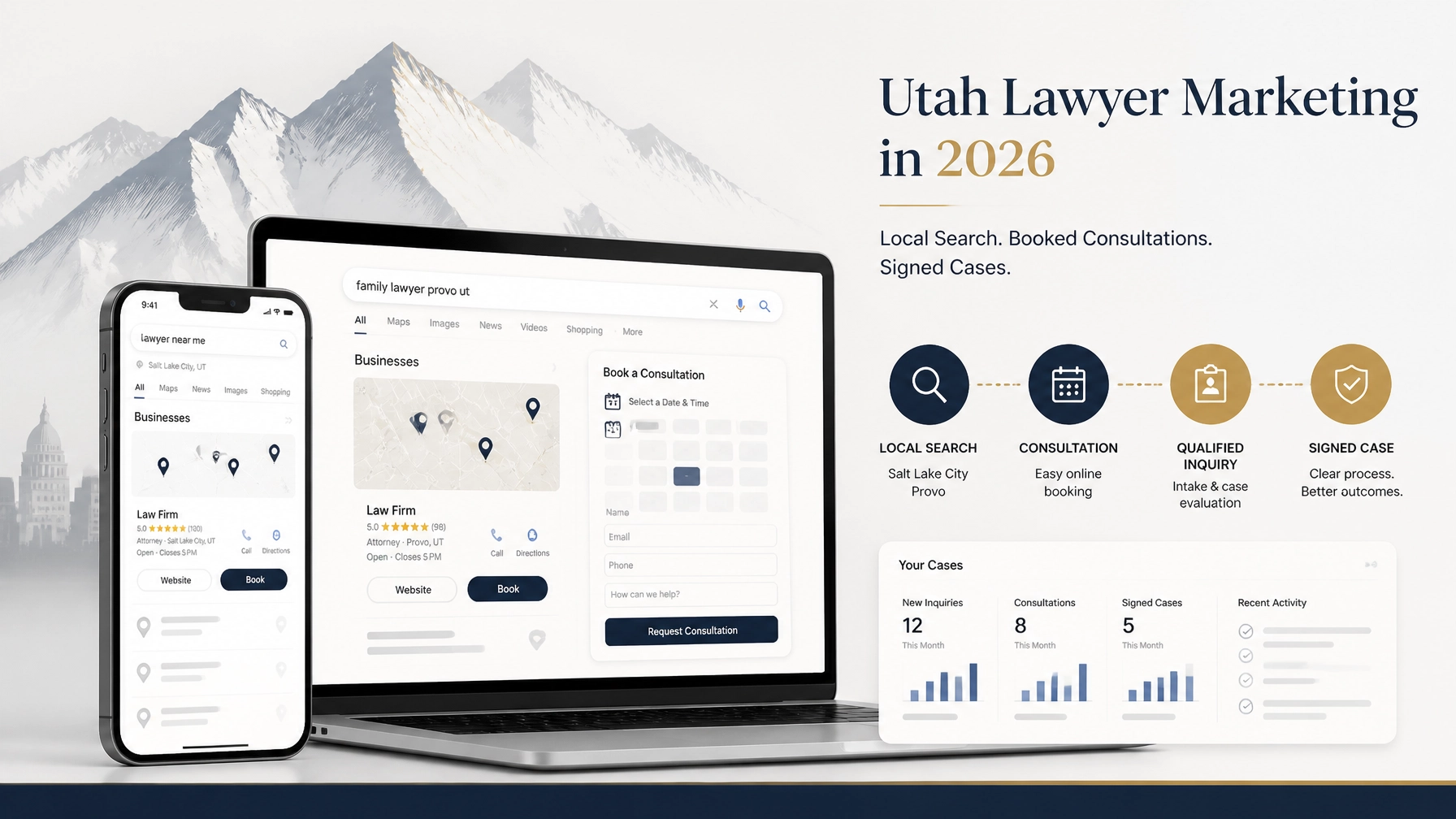
Effective Utah lawyer marketing connects four stages:
- The right local search.
- A credible result.
- A fast, useful intake experience.
- A measurable path to a signed case.
This guide shows you how to build that system across Salt Lake City, Provo, and the Wasatch Front.
Start With the Case You Want to Sign
Do not begin with generic traffic.
Begin with your most valuable practice areas, ideal clients, geography, and capacity. A personal injury firm may want more auto accident cases in Salt Lake City. A family law firm may want custody matters in Provo and Orem.
These goals require different pages, ads, intake questions, and budgets.
Create a simple priority list:
- Practice area.
- Target city or county.
- Estimated case value.
- Monthly case capacity.
- Minimum acceptable cost per signed case.
- Conflicts or case types you do not accept.
This list becomes the foundation for your legal lead generation strategy.
Build a Local Search Foundation
Optimize Your Google Business Profile
Your Google Business Profile for law firms is one of the most important local assets you control. It can appear in Maps, local search results, branded searches, and some AI-generated search experiences.
Start with accuracy.
- Use your real firm name.
- Use a legitimate office location that meets Google’s eligibility rules.
- Keep your name, address, and phone number consistent.
- Choose the most accurate primary category.
- Add relevant secondary categories only when they reflect real services.
- List practice areas clearly.
- Keep hours, holiday hours, phone numbers, and website links current.
- Upload real office, attorney, and team photos.
- Add clear answers to common questions.
Do not add keywords to your firm name. “Smith Law” should not become “Best Salt Lake City Personal Injury Lawyer Smith Law.” Keyword stuffing can create policy problems and reduce trust.
Review your profile monthly. Check calls, website visits, direction requests, search terms, and message activity. Connect this data to your intake records so profile activity can be evaluated by case quality.

Build Practice-Area and City Pages
One general “Practice Areas” page is not enough.
Create a dedicated page for each important service. Then create location pages only where you can provide genuinely useful, original information.
Examples include:
- Salt Lake City personal injury lawyer.
- Provo family law attorney.
- Orem estate planning lawyer.
- Sandy criminal defense attorney.
- West Jordan divorce lawyer.
- Lehi business litigation attorney.
A useful page should include:
- The legal problem you handle.
- Who the service is for.
- What a prospective client can expect during the first conversation.
- Relevant Utah law or court process information.
- Common questions.
- Your office location and service area.
- A clear consultation or case-evaluation CTA.
- Attorney credentials and responsible-firm information.
- A compliance review before publication.
Avoid copying the same page and changing only the city name. That approach creates thin content and weakens trust. Each page should reflect the local audience, actual service area, and specific search intent.
This is the core of law firm SEO Utah. You are not trying to rank one page for every legal query. You are building a relevant page for each case type you want to handle.
Make Local Visibility Convert
Improve the Website Before Increasing Traffic
More clicks will not solve a conversion problem.
Your website should answer three questions within seconds:
- Do you handle my type of case?
- Do you serve my location?
- What should I do next?
Use a clear headline. Put the primary phone number and consultation CTA in visible locations. Make the site fast and easy to use on mobile devices.
Your most important pages should include:
- A click-to-call phone number.
- A short case-evaluation form.
- Practice-area-specific trust signals.
- Attorney bios with useful credentials.
- Office location and service area details.
- Secure communication language.
- Expected response time.
- A clear privacy notice.
For a conversion-focused rebuild, review Wasatch Made’s web design services for lawyers.
Automate Intake Without Giving Legal Advice
A missed call can become a competitor’s signed case.
Use intake automation to respond quickly after a form submission, missed call, chat interaction, or ad inquiry. A chatbot or voice bot can collect basic information, identify the practice area, schedule a consultation, and route urgent inquiries to the right person.
It should not:
- Give legal advice.
- Promise an outcome.
- Decide whether an attorney-client relationship exists.
- Collect unnecessary sensitive information.
- Replace attorney review.
Set up an immediate confirmation message. Include the firm name, next step, and expected response time. If you use text messaging or call recording, review the process for privacy, consent, and professional responsibility requirements.

Use Reviews and Reputation Carefully
Reviews influence prospective-client trust. They can also support local relevance when they are legitimate, recent, and consistent.
Build a steady review process after appropriate matter milestones or case closure. Ask clients neutrally. Do not offer incentives. Do not ask only for positive reviews. Do not write reviews for clients or script their wording.
A simple request can say:
We value your feedback about your experience with our firm. If you choose to share it, you can use this review link. Please do not include confidential case information.
Respond to every review professionally. Never confirm representation, disclose case details, or debate facts in public. For a negative review, acknowledge the concern and invite private contact.
Have attorney leadership review review-request templates and public responses. Ethics rules may apply to testimonials, endorsements, past-result claims, and statements about experience.
Add Google PPC and Local Services Ads
Organic SEO compounds over time. Paid search can help you capture demand while your local visibility grows.
Use Google PPC for high-intent searches such as:
- “Hire a Salt Lake City DUI lawyer.”
- “Provo divorce attorney consultation.”
- “Utah personal injury law firm.”
- “Estate planning lawyer near Orem.”
Build separate campaigns by practice area and geography. Send each ad to a relevant landing page. Use negative keywords to remove searches for law school, legal jobs, free forms, definitions, and other non-client intent.
Local Services Ads can provide another channel for eligible law firms. Complete the required verification and maintain accurate practice-area information. Track calls and messages. Dispute irrelevant leads when appropriate.
Do not judge PPC or LSAs by clicks alone. Measure qualified inquiries, consultations, and signed cases.
Prepare for AI Search and GEO
People are asking AI tools longer, more specific questions.
They may ask:
- “Which family law firms serve Provo and Utah County?”
- “What should I bring to a Salt Lake City custody consultation?”
- “How do I find a Utah attorney for a business dispute?”
AI search/GEO for attorneys is not a shortcut or a guaranteed placement strategy. It is the process of making your firm’s information clear, consistent, authoritative, and easy for search systems to understand.
Improve your visibility by:
- Publishing direct answers to specific Utah legal questions.
- Identifying attorneys, practice areas, cities, and jurisdictions clearly.
- Using accurate organization and legal-service structured data.
- Linking to authoritative Utah resources where appropriate.
- Keeping your website, GBP, directories, and social profiles consistent.
- Updating outdated legal information.
- Reviewing every claim for accuracy and compliance.
AI systems may summarize your content. That makes accuracy more important, not less.
Track Cost Per Signed Case
Reports about impressions and traffic are incomplete.
Track the full funnel:
- Lead source.
- Search term or campaign.
- First contact date.
- Practice area.
- City.
- Qualified or unqualified status.
- Consultation booked.
- Consultation attended.
- Retained or declined.
- Revenue or expected matter value.
Use these basic measurements:
- Cost per lead: marketing spend divided by total inquiries.
- Cost per qualified case: marketing spend divided by qualified inquiries.
- Cost per consultation: marketing spend divided by completed consultations.
- Cost per signed case: marketing spend divided by retained matters.
The last number matters most.
A channel with fewer leads may produce more signed cases. A channel with cheap inquiries may consume intake time without creating revenue. Your CRM should make that difference visible.
A 90-Day Utah Lawyer Marketing Action Plan
Days 1–30: Fix the foundation
- Choose priority practice areas and target cities.
- Audit your Google Business Profile.
- Correct name, address, phone, categories, hours, and services.
- Review your website’s mobile speed and CTAs.
- Install call, form, chat, and source tracking.
- Define qualified-lead and signed-case stages.
- Review current advertising and website claims for compliance.
Days 31–60: Build conversion assets
- Create or improve priority practice-area pages.
- Publish unique Salt Lake City and Provo location pages.
- Add clear case-evaluation forms and click-to-call options.
- Create a compliant review-request workflow.
- Launch missed-call text and intake follow-up automation.
- Build focused PPC campaigns for high-intent searches.
- Apply for or optimize Local Services Ads if eligible.
Days 61–90: Improve what produces cases
- Compare leads by source, city, and practice area.
- Remove poor-performing keywords and audiences.
- Improve pages with high traffic but low conversion.
- Review call quality and intake response time.
- Publish useful Utah-specific FAQ content.
- Monitor AI search results for important questions.
- Report cost per qualified case and cost per signed case.
Build a Predictable Growth System for Your Utah Firm
You do not need more generic traffic. You need a system that connects local search visibility to qualified conversations and signed cases.
Wasatch Made brings 16 years of marketing experience to firms that want a clearer growth plan. We provide a data-backed 12-month projection, including estimated revenue opportunities and cost-per-client estimates before you spend a dime.
Our model is month to month. There are no long-term contracts.
Learn more about marketing systems for law firms, or contact Wasatch Made for a Utah-focused review of your search visibility, intake process, and case tracking.

Legal Marketing Disclaimer
This article is for general marketing and informational purposes only. It is not legal advice and does not create an attorney-client relationship. Marketing performance, rankings, inquiries, consultations, and signed cases are not guaranteed. Utah attorneys should review website copy, advertisements, testimonials, past-result statements, intake automation, tracking practices, and AI-generated content for compliance with current Utah Rules of Professional Conduct and other applicable requirements.